


Page 20 - Aquauclature Research and Studies (01)
P. 20
AQUAUCLATURE
                        Research and Studies 1 (1): 15-01, 2026                                                   page   of 193
                                                                                      10


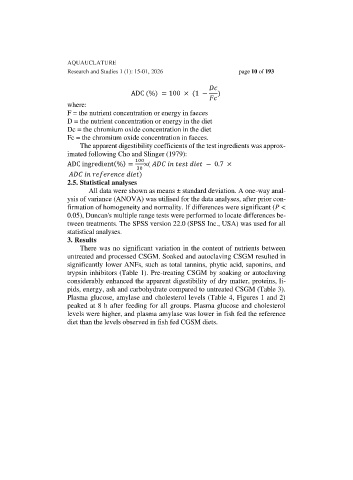
                                             ADC (%) = 100  × (1  −       )

                        where:
                        F = the nutrient concentration or energy in faeces
                        D = the nutrient concentration or energy in the diet
                        Dc = the chromium oxide concentration in the diet
                        Fc = the chromium oxide concentration in faeces.
                            The apparent digestibility coefficients of the test ingredients was approx-
                        imated following Cho and Slinger (1979):
                                               100
                        ADC ingredient(%) =       ×(                                −  0.7  ×
                                               30
                                                                )
                        2.5. Statistical analyses
                               All data were shown as means ± standard deviation. A one-way anal-
                        ysis of variance (ANOVA) was utilised for the data analyses, after prior con-
                        firmation of homogeneity and normality. If differences were significant (P <
                        0.05), Duncan's multiple range tests were performed to locate differences be-
                        tween treatments. The SPSS version 22.0 (SPSS Inc., USA) was used for all
                        statistical analyses.
                        3. Results
                            There was no significant variation in the content of nutrients between
                        untreated and processed CSGM. Soaked and autoclaving CSGM resulted in
                        significantly lower ANFs, such as total tannins, phytic acid, saponins, and
                        trypsin inhibitors (Table 1). Pre-treating CSGM by soaking or autoclaving
                        considerably enhanced the apparent digestibility of dry matter, proteins, li-
                        pids, energy, ash and carbohydrate compared to untreated CSGM (Table 3).
                        Plasma glucose, amylase and cholesterol levels (Table 4, Figures 1 and 2)
                        peaked at 8 h after feeding for all groups. Plasma glucose and cholesterol
                        levels were higher, and plasma amylase was lower in fish fed the reference
                        diet than the levels observed in fish fed CGSM diets.

