


Page 48 - Aquauclature Research and Studies (01)
P. 48
AQUAUCLATURE
                                                                                      38
                        Research and Studies 1 (1): 15-01, 2026                                                   page   of 193


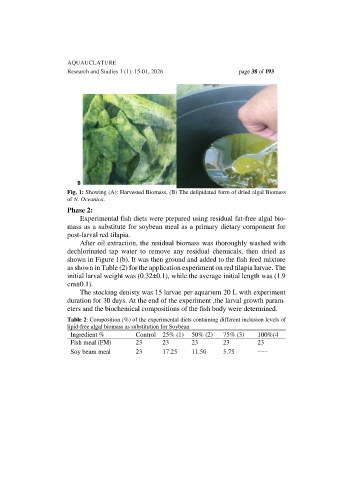
                        Fig. 1: Showing (A): Harvested Biomass, (B) The delipidated form of dried algal Biomass
                        of N. Oceanica.
                        Phase 2:
                            Experimental fish diets were prepared using residual fat-free algal bio-
                        mass as a substitute for soybean meal as a primary dietary component for
                        post-larval red tilapia.
                            After oil extraction, the residual biomass was thoroughly washed with
                        dechlorinated  tap  water  to  remove  any  residual  chemicals,  then  dried  as
                        shown in Figure 1(b). It was then ground and added to the fish feed mixture
                        as shown in Table (2) for the application experiment on red tilapia larvae. The
                        initial larval weight was (0.32±0.1), while the average initial length was (1.9
                        cm±0.1).
                            The stocking denisty was 15 larvae per aquarium 20 L with experiment
                        duration for 30 days. At the end of the experiment ,the larval growth param-
                        eters and the biochemical compositions of the fish body were determined.
                        Table 2: Composition (%) of the experimental diets containing different inclusion levels of
                        lipid-free algal biomass as substitution for Soybean
                         Ingredient %          Control   25% (1)   50% (2)   75% (3)    100%(4
                         Fish meal (FM)        23       23        23        23          23
                         Soy beam meal         23       17.25     11.50     5.75        ---

