


Page 55 - Aquauclature Research and Studies (01)
P. 55
AQUAUCLATURE
                        Research and Studies 1 (1): 15-01, 2026                                                   page   of 193
                                                                                      45

                         B4        0.25±0.01 e   1.71±0.01 e   1.46±0.01 ee   1.70±0.01 f   3.64±0.01 f
                         PM1       0.21±0.01 g   1.82±0.01 f   1.61±0.01 d   1.81±0.01 e   4.06±0.01 c
                         PM2       0.23±0.01 f   1.94±0.01 c   1.71±0.01 c   1.93±0.01 c   4.09±0.01 b
                         PM3       0.26±0.01 d   2.06±0.01 b   1.80±0.01 b   2.05±0.01 b   4.09±0.0 bb
                         PM4       0.25±0.01 ee   2.19±0.01 a   1.94±0.01 a   2.18±0.01 a   4.25±0.01 a
                        (IBW) Initial body weight – (FBW) Final body weight- (BWG) Body weight gain- (ADG)
                        Average daily   gain- (SGR) Specific growth rate
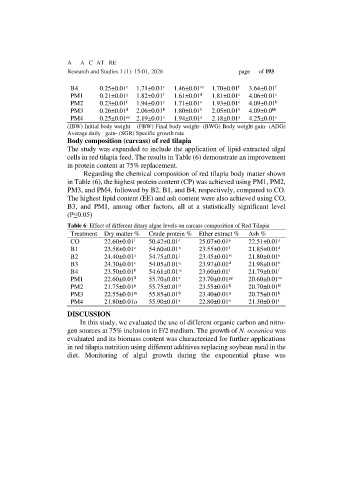
                        Body composition (carcass) of red tilapia
                        The study was expanded to include the application of lipid-extracted algal
                        cells in red tilapia feed. The results in Table (6) demonstrate an improvement
                        in protein content at 75% replacement.
                              Regarding the chemical composition of red tilapia body matter shown
                        in Table (6), the highest protein content (CP) was achieved using PM1, PM2,
                        PM3, and PM4, followed by B2, B1, and B4, respectively, compared to CO.
                        The highest lipid content (EE) and ash content were also achieved using CO,
                        B3,  and  PM1,  among  other  factors,  all  at  a  statistically  significant  level
                        (P≤0.05)

                        Table 6: Effect of different ditary algae levels on carcass composition of Red Tilapia
                         Treatment  Dry matter %   Crude protein %  Ether extract %   Ash %
                         CO         22.60±0.01 l   50.42±0.01 r     25.07±0.01 a     22.51±0.01 a
                         B1         23.58±0.01 e   54.60±0.01 n     23.55±0.01 l     21.85±0.01 d
                         B2         24.40±0.01 a   54.75±0.01 j     23.45±0.01 m     21.80±0.01 e
                         B3         24.30±0.01 c   54.05±0.01 q     23.97±0.01 d     21.98±0.01 b
                         B4         23.50±0.01 h   54.61±0.01 m     23.60±0.01 i     21.79±0.01 f
                         PM1        22.60±0.01 ll   55.70±0.01 e    23.70±0.01 gg    20.60±0.01 oo
                         PM2        21.75±0.01 p   55.75±0.01 d     23.55±0.01 ll    20.70±0.01 ll
                         PM3        22.55±0.01 m   55.85±0.01 b     23.40±0.01 n     20.75±0.01 k
                         PM4        21.80±0.01o    55.90±0.01 a     22.80±0.01 o     21.30±0.01 i
                        DISCUSSION
                            In this study, we evaluated the use of different organic carbon and nitro-
                        gen sources at 75% inclusion in F/2 medium. The growth of N. oceanica was
                        evaluated and its biomass content was characterized for further applications
                        in red tilapia nutrition using different additives replacing soybean meal in the
                        diet.  Monitoring  of  algal  growth  during  the  exponential  phase  was

